Product usage analytics is useful. I still wanted a live event feed

- Kyrylo Silin
- Telesink founder
Product usage analytics is useful. I use that kind of data, and I do not think Telesink should replace it.
The thing I kept reaching for was more like a terminal than a dashboard. Give me the stream. Let me filter it quickly. Let me keep the important signals in view.
Analytics is for looking back
Tools like PostHog, Mixpanel, and Amplitude are good when you want to understand behavior over time. They help with funnels, cohorts, retention, attribution, feature adoption, and all the questions that need a proper dataset behind them.
That is real work. If I want to know whether onboarding improved after a design change, product usage analytics is the right shape. If I want to compare feature usage between free and paid accounts, I want the chart.
The problem is that not every question deserves that much machinery.
What I kept missing
When I am close to a product, I do not only care about historical analysis. I also want to feel the product breathing.
Someone signed up. A trial started. A payment came in. A customer upgraded. Someone cancelled. A user reached an onboarding milestone. An important feature got used for the first time.
None of those moments need a big report right away. Most of the time I just want to notice them. Later, maybe I will study the pattern. In the moment, I want the tiny signal that says: this is happening now.
High-signal events
I do not want every tiny interaction in Telesink. That belongs in product analytics. Telesink works best when the events are high signal.
High signal does not always mean dramatic. It just means the event is worth noticing on its own. A signup, a payment, a cancellation, an upgrade, an activation, a meaningful feature use. If I see it in the feed, I should understand why it matters.
This is where the live feed feels different from analytics. Analytics wants all the raw behavior so it can explain patterns later. Telesink wants the moments that are already meaningful enough to read now.
The events worth seeing live
For Telesink, I think the best events are the ones that mean something to the business or the customer experience. They should also read like human language. I want to glance at the feed and understand the moment without translating an internal code name in my head.
- User signed up: someone created an account
- Checkout intent created: someone asked to buy
- Payment succeeded: revenue came in
- Subscription activated: a paid account went live
- Entitlement unlocked: the product changed for the customer
- Game completed: someone reached the end of a flow
- Result shared: someone wanted to show the outcome
This is closer to custom event tracking than classic analytics. You decide which moments matter, name them clearly, and send them to a place where a human can read them.
How I use it
I already use Telesink on two small products: Flagmatch and Flagclick. They are good examples because neither one needs a huge analytics story for every interaction. I mostly want to know when something meaningful happened.
On Flagmatch, the useful events are product moments with names I can read quickly: User signed up, Game started, Game completed, Game abandoned, Game hint used, Share result clicked, Game result shared, and Flag emoji copied. The paid flow has its own signals, like Remove ads checkout intent created, Remove ads entitlement unlocked, Premium checkout intent created, and Premium subscription activated.
That is a lot of names in one paragraph, but it is not random noise in the product. The events cluster around real product questions: did someone start playing, finish playing, get stuck, share something, copy something, or pay for something? Those are the moments I want to notice.
I also attach enough context to make the events useful later: the page, session, deck, quiz, checkout source, plan, share method, or copy type. Then I can filter the stream when I want to answer a narrow question. Show me premium checkout events. Show me sharing events. Show me hint usage. Show me what happened on this page today.
Flagclick is even more important as a filter example. It is a clicker game, so sending every click would be useless. The product sends threshold and rank events instead: New country joined, Country crossed 100 clicks, Country crossed 1,000 clicks, Country took the lead, Country lost the lead, Country entered the top three, Country entered the top ten, and Country left the top ten. It also sends quiet abuse signals like Submit token replay detected, IP click bucket saturated, Suspicious clicking discounted, and Too many sessions from IP.
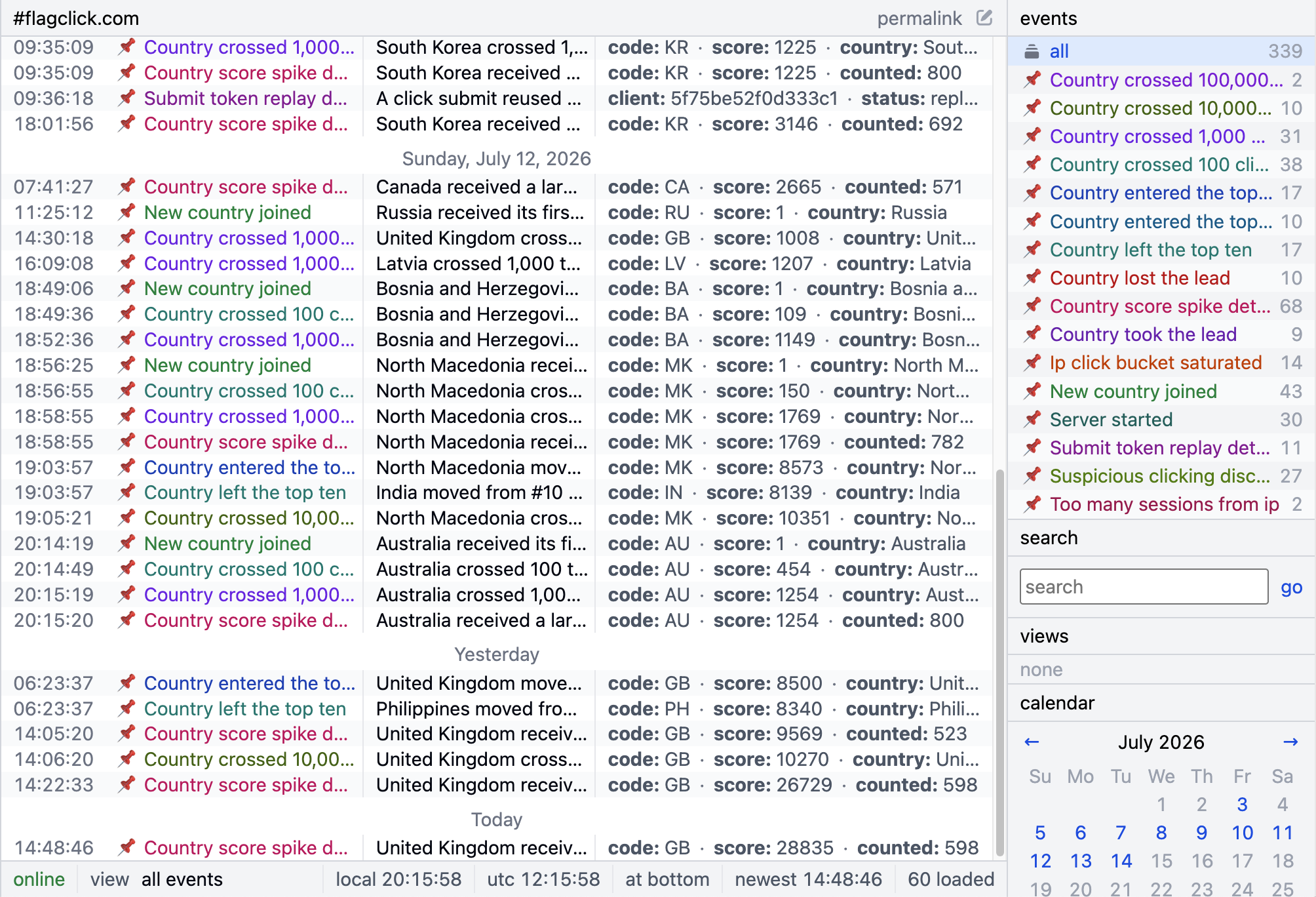
A real Flagclick sink in Telesink. The feed is full of high-signal product events, with filters on the side for the moments I want to inspect.
That is exactly the line I want Telesink to encourage. Do not send every low-level interaction. Send the state changes, milestones, and signals you would actually stop to read.
Grep for product events
The inspiration for Telesink is closer to Unix tools than analytics
software. I like the feeling of piping output through grep
until the noise falls away and the thing I care about is left on
screen.
That is the mental model I want for product events. The stream keeps moving. Then you narrow it down.
- Filter by event type when you only care about payments or cancellations
- Search the text when you remember a customer, email, plan, or phrase
- Filter by date when you want to inspect what happened today
- Filter by properties when a value inside the event matters
- Save useful views so the same filter is one click away next time
- Keep filtered columns for the streams you watch often
This is why the feed matters. A feed without filtering becomes another noisy inbox. A feed with good filters becomes something you can work with.
Where Telesink fits
Telesink is my answer to that missing layer. It is product event tracking for high-signal moments you want to notice now, not a full analytics system for every possible question later.
I want it to sit next to analytics tools, not fight them. Send the important live moments to Telesink. Send the full behavioral dataset to your analytics tool. Those are different purposes.
The interface reflects that. Telesink is mostly text, because the useful part is the event itself. What happened? When did it happen? Which customer or account did it affect? What small bit of context makes it readable? Then, just as important, how do I filter the stream to the part I care about?
When this is not the right tool
If you need retention analysis, attribution, session replay, funnel breakdowns, cohort reports, or a source of truth for product metrics, use a product analytics tool.
Telesink should not become that. The whole reason I am building it is that I wanted the smaller thing.
Product usage analytics helps me understand what happened over time. A filtered live event feed helps me notice what is happening right now.
I want both. Telesink is for the second one.